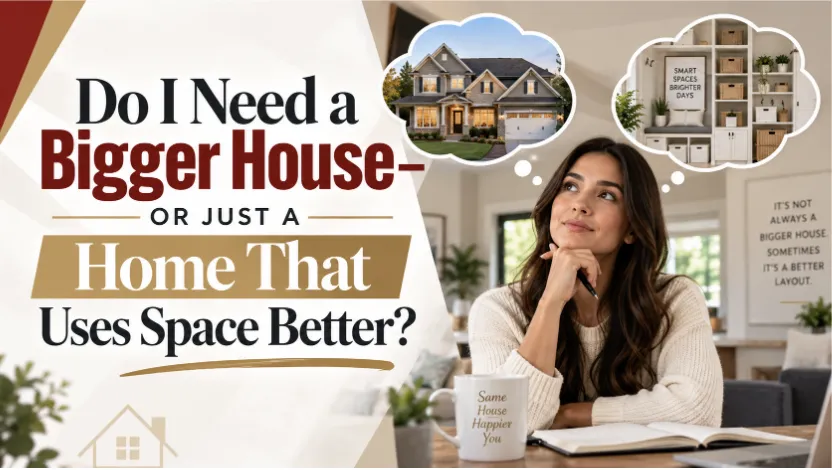
Do I Need a Bigger House—or Just a Home That Uses Space Better?
Sometimes your home feels too small because you truly need more room.
Other times, the problem is not the size.
It is how the space works.
Maybe your house has enough square footage, but the storage is poor.
Maybe you have a formal dining room no one uses, while your kitchen feels crowded every evening.
Maybe you have three bedrooms, but no quiet place to work from home.
Or maybe your family spends most of its time in one part of the house because the rest of the layout does not fit the way you live.
That is why Augusta-area Move-Up Buyers should ask an important question before deciding they need a much larger home:
“Do I need more square footage—or do I need a home that uses its square footage better?”
Current 2026 home-design research points toward smaller, smarter floor plans that put more focus on function, storage, flexible rooms, and usable outdoor space rather than size alone.
Here is how to figure out which kind of move may make the most sense for you.
1. Start With What Feels Too Small
Do not begin with a square-footage number.
Begin with the frustration.
What makes your current home feel like it no longer works?
Maybe:
The kitchen is crowded
There is not enough storage
You need another bedroom
You need a home office
Everyone shares one bathroom
The laundry area is inconvenient
The living room feels cramped
There is nowhere for guests
The garage is full of household items
The yard does not fit your needs
Now separate those problems into two groups.
Problems more space might solve:
Not enough bedrooms
Not enough bathrooms
A yard that is too small
No garage
No room for guests
No possible office space
Problems a better layout might solve:
Poor storage
Wasted formal rooms
Bad kitchen flow
Long hallways
Rooms that are too separated
Rooms with no clear purpose
An overly open space with no quiet areas
This is where the decision becomes much clearer.
2. Square Footage Does Not Tell You How a Home Feels
Two homes can have nearly the same amount of square footage and feel completely different.
One may have:
Long hallways
A huge foyer
Formal rooms you rarely use
Small closets
An awkward kitchen
Another may use the same space for:
Larger closets
A useful pantry
A home office
Better bedroom sizes
An open but organized kitchen and living area
Current 2026 design research shows builders are putting more attention on efficient plans that reduce wasted space and make each room work harder.
For Move-Up Buyers, that means you should not ask only:
“How many square feet is it?”
Ask:
“How much of this house will I actually use?”
3. Storage Can Make a Home Feel Much Larger
A lack of storage can make a home feel crowded even when the room sizes are fine.
Think about your current home.
Where do the everyday things go?
Shoes.
Backpacks.
Cleaning supplies.
Food.
Holiday decorations.
Sports equipment.
Towels.
Extra bedding.
If those items do not have a home, they end up in the rooms where you are trying to live.
That makes the house feel smaller.
A better-designed home may include:
Walk-in pantry
Linen closets
Large bedroom closets
Laundry-room storage
Garage storage
Mudroom or drop zone
Built-in shelving
Attic storage
Current home-design trends are placing more value on storage that is built into everyday living spaces rather than simply adding more rooms.
For some homeowners, more storage may solve the space problem better than another 500 square feet.
4. Look at the Rooms You Rarely Use
Walk through your current home and ask:
“Which rooms do we actually use every week?”
Then ask:
“Which rooms mostly sit empty?”
Maybe you have:
A formal dining room
A formal living room
A large foyer
An unused guest room
A loft no one uses
The room is technically part of your square footage.
But if it does not serve your life, it is not helping you.
Current design trends are moving away from layouts built around large formal spaces and toward rooms that can serve several purposes.
Your next house may not need to be much larger if its rooms work harder.
5. A Flexible Room Can Solve Several Problems
One of the most useful features for Move-Up Buyers can be a room without one fixed purpose.
A flexible room could become:
Home office
Playroom
Guest room
Workout space
Study area
Hobby room
Second living area
And its purpose can change later.
Recent housing research continues to show interest in flexible spaces because households use their homes for more activities than they did in the past.
That can help you avoid buying a house with several extra rooms just to prepare for every possible future need.
One smart room may do the work of several.
6. Too Much Open Space Can Create Its Own Problems
For years, open floor plans were a major goal for many homeowners.
But completely open space does not work for everyone.
If someone is cooking, another person is watching television, and someone else is trying to work or study, one giant room may suddenly feel less useful.
Current 2026 design trends show growing interest in layouts that stay connected while giving homeowners more defined areas and quieter spaces.
That may mean:
A separate office
A small study nook
A living area with defined zones
A flex room
A kitchen that connects to the living room without everything being one large space
Sometimes the answer is not more square footage.
It is better separation.
7. Your Kitchen May Be the Real Problem
A home can feel too small when the kitchen does not work.
Ask yourself:
Is there enough counter space?
Do you have enough cabinets?
Is there a pantry?
Can two people cook comfortably?
Is the refrigerator blocking a walkway?
Is there enough room to gather?
Does the kitchen connect well to the living area?
A more functional kitchen may change the way the entire home feels.
Current 2026 buyer trends continue to put strong emphasis on kitchen function and storage, including larger pantries and better organization.
Do not assume you need a giant kitchen.
You may simply need one that is designed better.
8. Ask Whether Your Current Home Could Be Improved
Before deciding to move, look at whether some of your frustrations could be fixed.
Could you:
Add storage?
Turn a formal dining room into an office?
Convert a closet into a work area?
Add built-ins?
Rework furniture placement?
Open or define part of the floor plan?
Finish an unused room?
Some changes may be simple.
Others may require a larger renovation.
If changing the current house solves most of the problem, staying may deserve consideration.
If the house still cannot give you the bedrooms, yard, location, or basic layout you need, moving may make more sense.
9. Some Problems Cannot Be Solved With Better Design
There are limits to what a smarter floor plan can do.
You may truly need more space if:
You need another bedroom and there is nowhere to create one
You need another bathroom
Your lot is too small
You need a larger garage
You want more privacy
You need space for a multigenerational household
Your home has no flexible area to repurpose
And some problems are not about the house at all.
Maybe you want:
A different commute
A different part of the CSRA
More land
A newer neighborhood
Different community amenities
A better furniture arrangement cannot solve a location problem.
This is why the decision should begin with the real reason you want to move.
10. Outdoor Space Can Add Living Space Too
Do not forget the outside.
A covered patio, porch, deck, or useful backyard can extend how you use your home.
Current buyer research shows outdoor spaces remain important because homeowners increasingly treat them like additional living and gathering areas.
If you enjoy spending time outside, a home with a useful patio and smaller interior may work better for you than a larger house with outdoor space you do not enjoy.
Ask:
“How much of this whole property can I actually use?”
Not just:
“How big is the house?”
Bigger or Better: How Do You Decide?
Try this simple test.
You may need a bigger house if:
You truly need additional bedrooms
You need more bathrooms
You need a larger yard
You need more garage space
Your household has grown
Your current home cannot be changed enough to meet your needs
You may need a better layout if:
You have rooms you rarely use
Storage is the main problem
The kitchen layout is frustrating
Your home lacks flexible spaces
Too much square footage is tied up in hallways or formal rooms
You need better separation for work, study, or quiet time
You may also need both.
That is okay.
The goal is to know what you are searching for before you start touring homes.
Do Not Buy Extra Space Just Because You Can
When you are approved to spend more, it can be tempting to make the next house much larger.
But every extra room brings more space to:
Heat and cool
Clean
Furnish
Maintain
Repair
Your next home should give you the room you need without adding space that does not serve a purpose.
Current home-design trends toward smaller but more functional homes are a good reminder that more house is not automatically more useful house.
What Should You Do Before Starting Your Search?
Take these three steps.
1. Make a frustration list
Write down what does not work in your current house.
2. Decide which problems require more square footage
Separate true space needs from layout and storage problems.
3. Tour homes by function, not just size
When you look at the next home, ask:
Where will everything go?
How will we use this room?
Does the kitchen work?
Is there enough storage?
Can we find privacy when we need it?
Does this solve the reasons we wanted to move?
Those questions can keep you from buying more house than you need—or moving into a bigger home that still feels frustrating.
Frequently Asked Questions
How do I know if I truly need a bigger home?
Start with the problems in your current home. If you need more bedrooms, bathrooms, yard, garage space, or space for more people and your current home cannot provide them, a larger home may make sense.
Can a smaller home with a better floor plan feel bigger?
Yes. Efficient layouts, better storage, less wasted hallway space, and flexible rooms can make a home feel much more useful. Current 2026 housing trends show builders are putting more attention on smarter use of space rather than raw square footage alone.
Is storage more important than another room?
It depends on your needs. If clutter is making your home feel small, better storage may help more than adding another room you do not use regularly.
Should I renovate my current home instead of moving?
It may be worth exploring if you like your location and the home can realistically be changed to solve your biggest problems. If the lot, bedroom count, location, or basic layout cannot meet your needs, moving may deserve a closer look.
Are open floor plans still popular?
Many buyers still like connected living spaces, but current 2026 design trends show growing interest in layouts that also create defined areas for working, studying, privacy, and quieter activities.
Should I buy extra bedrooms for future needs?
Think about your likely needs over the next several years, but do not assume you need a room for every possible future situation. A flexible room may serve several purposes over time.
Meet Sherry Sanders
For Sherry Sanders, helping someone move up starts with one question:
What do you need your next home to do that your current home cannot?
Sometimes the answer is more square footage.
Sometimes it is a smarter layout, better storage, more land, a different location, or simply a home that makes everyday life easier.
As a former educator in both Richmond County and Columbia County, Sherry brings a teacher's approach to real estate. She helps homeowners break big decisions into simple questions so they can understand what they truly need before they start looking at homes.
Her strong community relationships also give clients access to local resources that can be helpful throughout the buying and selling process.
Backed by more than two decades of local sales and leadership experience in real estate, Sherry specializes in helping Augusta-area Move-Up Buyers sell the home they have and find the home that fits what comes next.
If your current home feels crowded and you are trying to decide whether you need more square footage or simply a better home, Sherry can help you figure out what belongs at the top of your next-home list.
Thinking about moving up in Augusta or the CSRA?
📞 Call Sherry Sanders at 706-877-7005
🌐 Visit Sherry Sanders Realtor: https://sherrysandersrealtor.com/
#SoldOnSherry