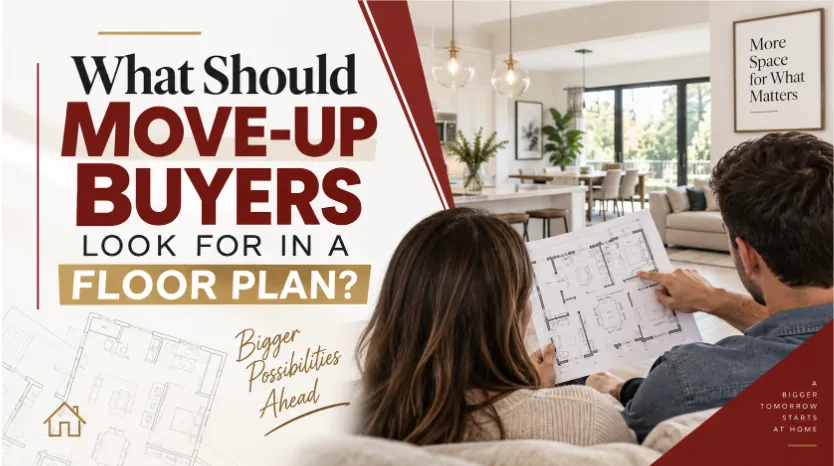
What Should Move-Up Buyers Look for in a Floor Plan?
When you are ready to move into a bigger home, it is easy to focus on one number:
Square footage.
A home with 2,800 square feet may sound like a huge improvement over the house you own now.
But bigger does not automatically mean better.
What matters is how those square feet are used.
A larger home can still feel crowded if the rooms are in the wrong places, storage is limited, or the layout does not match the way you live.
That is why I encourage Augusta-area Move-Up Buyers to look beyond the bedroom count and total square footage.
Ask:
“Will this floor plan actually make my everyday life easier?”
Current 2026 home-design research shows buyers are putting more value on function, storage, flexible rooms, and smarter use of space rather than size alone.
Here are the things I would look at before deciding whether a floor plan truly works for your next stage.
1. Start With the Problem You Are Trying to Solve
Before walking into your first home, think about what is not working in the house you already own.
Maybe:
Everyone gathers in a kitchen that feels too small
Two people are sharing a bedroom
You do not have a home office
Your closets are packed
The laundry room is in an inconvenient place
There is nowhere for guests
The living room feels crowded
You need more privacy
You want more room to spread out
Your next floor plan should solve those problems.
Otherwise, you may end up buying a larger version of a home that still does not work.
2. Look at Where the Bedrooms Are Located
Bedroom placement can have a big effect on how a home feels.
Think about what works best for your household.
Do you want all the bedrooms upstairs?
Would you rather have the primary bedroom on the main floor?
Do you want bedrooms close together or more separated?
Would a guest bedroom on the main level be useful?
A main-level bedroom or full bathroom can also give a home more flexibility for guests or future needs. Recent home-design research shows buyers continue to value a full bathroom on the main level for convenience and long-term flexibility.
Do not look only at the number of bedrooms.
Look at whether their placement works.
3. Pay Attention to How the Kitchen Connects to the Living Space
For many Move-Up Buyers, the kitchen is one of the biggest reasons for wanting a different home.
But a larger kitchen is not automatically a better kitchen.
Look at how it connects to the rest of the house.
Ask:
Can people move through the space easily?
Is there enough counter space?
Is the island in a useful location?
Can someone cook while other people are nearby without everyone getting in the way?
Is the dining area close enough to make sense?
Can you see into the living space if that matters to you?
Current buyer research shows that functionality is becoming more important than having a kitchen that simply looks impressive.
A pretty kitchen may catch your eye.
A functional kitchen can make everyday life easier.
4. Look for Storage Where You Actually Need It
Storage is one of those features you may not fully appreciate until you do not have enough of it.
Move-Up Buyers should look for storage throughout the home, not just in the primary closet.
Think about:
Pantry space
Linen closets
Bedroom closets
Coat closets
Laundry storage
Garage storage
Attic storage
Mudroom or drop-zone storage
Space for cleaning supplies
Places for sports equipment or seasonal items
Current 2026 design research describes storage as one of the most important ways homes are becoming more functional, with buyers showing strong interest in pantries, utility storage, and drop zones.
A home may have plenty of square footage but still feel cluttered if there is nowhere to put things away.
5. Think About Your Daily Traffic Flow
This is something buyers often miss during a showing.
Imagine your normal morning.
Where will everyone walk?
From the bedrooms to the bathrooms.
From the kitchen to the garage.
From the garage into the house.
From the laundry room to the bedrooms.
From the front door to the main living area.
Now imagine everyone doing those things at the same time.
Does the layout feel easy?
Or will people constantly cross through the same small space?
A floor plan should help your household move through the home without creating unnecessary traffic jams.
This is one reason efficient layouts can sometimes feel better than homes with more total square footage.
6. Look Closely at the Laundry Room
Laundry may not be the most exciting part of a home tour.
But it is something you use constantly.
Think about:
Is the laundry room near the bedrooms?
Do you have to carry laundry across the house?
Is there room to sort or fold clothes?
Is there storage for supplies?
Is it a real room or just a small closet?
Does the laundry area create noise near the main living space?
Current buyer-preference research shows that dedicated laundry rooms remain a highly valued practical feature.
A well-placed laundry room can make a larger home feel much easier to manage.
7. Look for a Flexible Room
Your life can change.
Your floor plan should have room to change with it.
A flexible room might be used as:
Home office
Guest room
Playroom
Workout room
Hobby room
Study area
Second living room
Current housing research shows that buyers are placing more value on rooms that can serve more than one purpose.
When you tour a home, do not ask only:
“What is this room supposed to be?”
Ask:
“What could this room become if my needs change?”
That can help your next home work for you longer.
8. Do Not Let an Impressive Foyer Waste Your Space
Some floor plans look dramatic when you first walk through the door.
There may be a tall foyer, wide hallway, or large formal space.
But ask yourself how much of that square footage you will actually use.
Current home-design trends are moving toward more efficient layouts that reduce wasted space and make rooms work harder.
For a Move-Up Buyer, usable space may be more valuable than impressive space.
Would you rather have a large foyer you walk through quickly or a larger pantry you use every day?
That is the kind of trade-off worth thinking about.
9. Think About Privacy
A larger home should give you more breathing room.
Look at how the layout handles privacy.
Ask:
Is the primary bedroom right beside the living room?
Can guests see directly into bedrooms from common areas?
Is a home office near noisy rooms?
Are children's bedrooms located where you are comfortable with them?
Does the guest space feel separate enough?
An open floor plan can feel bright and social.
But too much openness may also make it harder to find a quiet place.
The best floor plan may give you both:
connection when you want it and separation when you need it.
10. Think About the Garage Entry
This can tell you a lot about how the house will work every day.
Most people do not enter their home through the front door every time.
If you will regularly come in through the garage, look at what happens next.
Is there:
A place for shoes?
Somewhere to put bags?
Storage for coats?
A nearby pantry?
Easy access to the kitchen?
A mudroom or drop zone?
Current home-design research shows growing interest in drop zones and organized entry spaces because they help control everyday clutter.
A small, well-designed entry can make a big difference.
11. Make Sure the Outdoor Space Connects to the Home
If outdoor living is important to you, look at how the inside and outside work together.
Does the kitchen open onto the patio?
Is the backyard easy to reach from the main living area?
Can you picture carrying food outside for dinner?
Is there room to entertain?
Current buyer research continues to show strong interest in usable outdoor living and indoor-outdoor connections.
A large backyard may be wonderful.
But a yard that connects naturally to the house may be even more useful.
12. Think About What the Floor Plan Will Need to Do Five Years From Now
A Move-Up Buyer should think beyond today.
Ask yourself:
What may change before I am ready to move again?
Maybe you will need:
Another bedroom
A permanent home office
Guest space
More privacy
A main-level bedroom
Space for an older relative
A room that can change uses
More storage
You do not need to buy space you cannot afford just because you might use it later.
But a flexible floor plan can help you avoid outgrowing the next home too quickly.
That is one reason adaptable layouts are getting more attention in current home design.
Bigger Is Not the Same as Better
This is one of the biggest things I want Move-Up Buyers to remember.
You can tour one house with 3,200 square feet and another with 2,700 square feet.
The smaller one may actually work better.
Why?
Because it may have:
Better storage
Less wasted hallway space
A useful bonus room
Better bedroom placement
A smarter kitchen
A better laundry location
Do not let square footage make the decision for you.
Walk through the home and imagine living there on a regular Tuesday.
That will tell you much more.
What Should You Do During a Showing?
When you tour your next Augusta-area home, try this:
Walk through your morning
Where will everyone get ready?
Walk through dinner time
Does the kitchen and living space work?
Walk through laundry day
Is the laundry room convenient?
Walk through coming home
Where do bags, shoes, coats, and groceries go?
Walk through a busy weekend
Where will guests gather?
Where can someone go if they need quiet?
Thinking this way helps you see the floor plan, not just the finishes.
Frequently Asked Questions
Is an open floor plan better for Move-Up Buyers?
It depends on how you live. Open layouts can make gathering and entertaining easier, while some buyers also want separate spaces for work, guests, or quiet time. Current design trends are leaning toward layouts that feel open while still creating useful zones.
Should I look for a primary bedroom on the main floor?
It may be worth considering if you want fewer stairs, more separation from other bedrooms, or a layout that could work well over a longer period. The right choice depends on your household and preferences.
How important is storage in a larger home?
Very important. A larger home can still feel crowded without enough storage. Look for closets, pantry space, garage storage, laundry storage, and practical places to put everyday items.
Is a bonus room worth having?
It can be if you will actually use it. Bonus or flex rooms can serve as an office, guest room, playroom, workout room, or hobby space as your needs change.
Is square footage the best way to compare floor plans?
No. Square footage tells you how much space a home has, but it does not tell you how useful that space is. Compare room sizes, storage, traffic flow, layout, and how the spaces connect.
Should I think about resale when choosing a floor plan?
It can be one factor, but your own needs should come first. Practical layouts, storage, indoor laundry, garages, and flexible spaces currently have broad buyer appeal, but no floor plan guarantees a future sale price.
Meet Sherry Sanders
For Sherry Sanders, moving up is not about helping someone buy the house with the biggest square-footage number.
It is about finding a home that actually works better for the way you live now and the life you are building next.
As a former educator in both Richmond County and Columbia County, Sherry brings a teacher's approach to real estate. She helps buyers slow down, look beyond the pretty finishes, and ask practical questions about how a home will work once they move in.
Her strong community relationships can also connect clients with useful local resources throughout the buying and selling process.
Backed by more than two decades of local sales and leadership experience in real estate, Sherry specializes in helping Augusta-area Move-Up Buyers sell the home they have and find the next one with the space, layout, and features they actually need.
If you have outgrown your current home and are looking in Augusta, Evans, Martinez, Grovetown, or another part of the CSRA, Sherry can help you compare more than bedroom counts and square footage.
Thinking about moving up in Augusta or the CSRA?
📞 Call Sherry Sanders at 706-877-7005
🌐 Visit Sherry Sanders Realtor: https://sherrysandersrealtor.com/
#SoldOnSherry