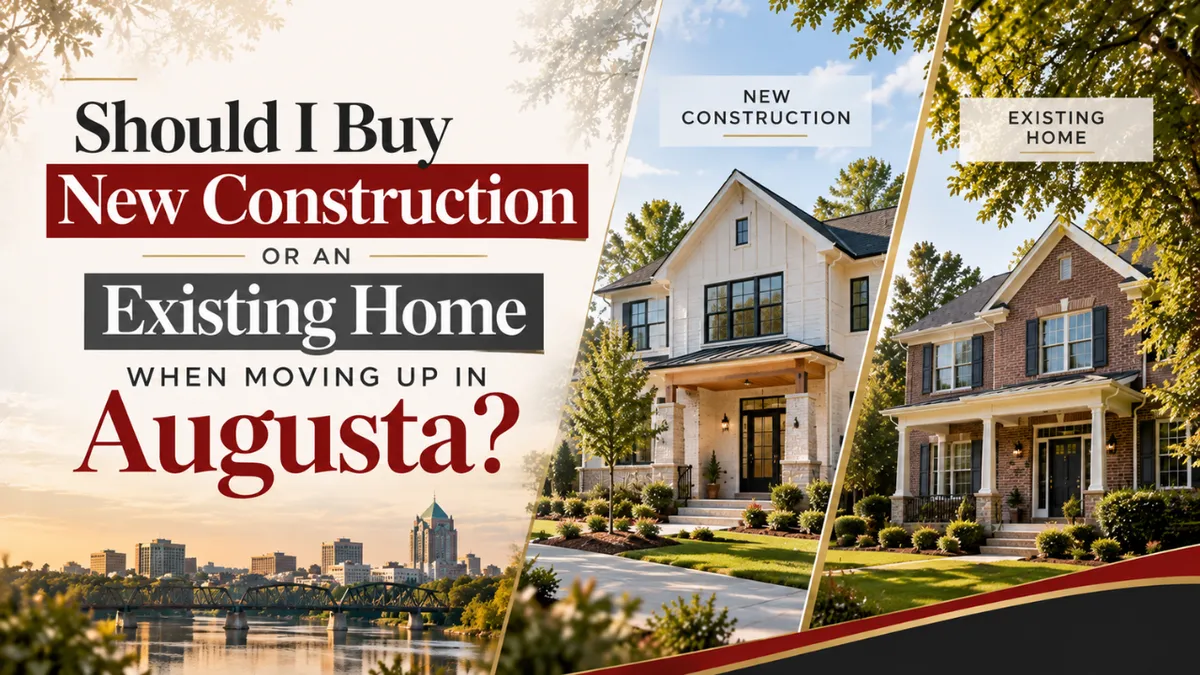
Should I Buy New Construction or an Existing Home When Moving Up in Augusta?
If your current home is starting to feel too small, you may already know what you want next.
More bedrooms.
A bigger kitchen.
More storage.
A home office.
A larger yard.
Maybe even a bonus room where everyone can spread out.
But once you decide to move up, another question often comes next:
Should I buy a brand-new home or an existing home?
That is a big decision for Augusta-area Move-Up Buyers.
New construction can offer fresh finishes, modern floor plans, and less updating when you move in.
An existing home may give you an established neighborhood, mature landscaping, a larger lot, or a location that works better for your daily life.
The right answer depends on your needs, your budget, your timeline, and what you want your next home to do for you.
Here are some things to think about before choosing.
1. Start With the Reason You Are Moving Up
Before you compare new and existing homes, go back to the reason you want to move.
Ask yourself:
What does my current home no longer give me?
Your list might include:
Another bedroom
A larger kitchen
More bathrooms
Better storage
A home office
A bonus room
A larger yard
A garage
A more open floor plan
Space for guests
Room for your next stage of life
This list matters because it is easy to get excited about something new and forget the real reason you started looking.
A beautiful model home can get your attention.
So can an existing home with a big yard and mature trees.
Your job is to figure out which one actually solves the problem.
2. What Are the Benefits of New Construction?
One of the biggest reasons Move-Up Buyers consider new construction is simple:
Everything feels new.
You may find new appliances, newer systems, modern finishes, and floor plans designed around the way many people live today.
Current listings show a large amount of new-construction activity in Columbia County, especially in Grovetown. That gives Augusta-area buyers several communities and floor plans to compare.
New construction may be a good fit if you want:
Open floor plans
Larger kitchens
Walk-in closets
Extra bedrooms
Newer building materials
New appliances
Modern finishes
Less immediate updating
Community amenities
A home designed for today's lifestyle
For a Move-Up Buyer leaving a smaller starter home, those features can feel like a major step forward.
3. New Construction Can Give You More Choices
Depending on the home and builder, you may be able to choose certain finishes or features.
That could include:
Flooring
Cabinets
Countertops
Paint colors
Lighting
Some layout choices
Lot location
But it depends on how far along the home is.
A home that is already finished may offer fewer choices than one that has not yet been built.
This is something to ask about early.
You should also understand which features are included in the base price and which ones cost extra.
The model home may include upgrades that are not part of the standard home.
Ask questions before assuming everything you see is included.
4. What Are the Benefits of an Existing Home?
Existing homes can offer things that are harder to find in some new neighborhoods.
You may find:
Mature trees
Larger lots
Established streets
Finished landscaping
Fences already in place
Window treatments
Updated kitchens
Built-in storage
Older home styles with more character
Locations closer to places you already use
An existing home can also help you see exactly what you are buying.
The home is already there.
You can walk through it.
You can look at the yard.
You can see the street.
You can get a better feel for the neighborhood before making your decision.
That can be very helpful when you are trying to picture your everyday life there.
5. Think About Location Before You Choose New or Existing
Sometimes the decision is not really about the age of the house.
It is about where the house is located.
Maybe you find a new home with the floor plan you love, but the drive to work is longer than you want.
Or maybe an existing home is closer to work, shopping, family, school, or the places you visit most.
Before making a decision, think about your normal week.
Where do you go?
How often?
How long will the drive take?
A home can look perfect inside and still create stress if the location does not work for your daily life.
6. What About Maintenance?
Many Move-Up Buyers like the idea of new construction because major systems are new.
That can mean fewer immediate updates when you move in.
But new does not mean maintenance-free.
You still need to care for:
HVAC systems
Plumbing
Appliances
Landscaping
Gutters
Exterior surfaces
Your yard
With an existing home, some systems may be older.
That is why the inspection process matters.
Before buying, pay attention to the age and condition of things such as:
Roof
HVAC system
Water heater
Windows
Plumbing
Electrical systems
Appliances
An older home may still be a great fit if it has been well cared for.
The key is knowing what you may need to repair or replace later.
7. Do Not Compare Price Alone
Move-Up Buyers sometimes look at a new home and an existing home and compare only the listing prices.
That is not enough.
Think about the total cost of each choice.
For new construction, ask about:
Builder upgrades
Lot premiums
HOA fees
Landscaping
Fencing
Window coverings
Appliances that may not be included
Closing costs
For an existing home, think about:
Repairs
Updates
Paint
Flooring
Roof age
HVAC age
Other work you may want after closing
A lower purchase price does not automatically mean the home will cost less after you move in.
Look at the full picture.
8. Builder Incentives Can Be Helpful — But Read the Details
Builders sometimes offer incentives to help buyers with things such as closing costs, upgrades, or financing.
Current Augusta-area builders are advertising incentives on certain homes, showing that these offers are part of today's local new-construction market.
But incentives can change.
They may also depend on:
The home
The community
The closing date
The lender you use
The builder's current promotion
Do not choose a new home based only on an incentive.
Ask what you are receiving, what conditions apply, and whether the home itself fits your needs.
Any builder incentive should be confirmed directly before you make a buying decision.
9. Your Timeline Matters When You Already Own a Home
This is where Move-Up Buyers have a different challenge from many first-time buyers.
You already have a home.
That means you may be thinking about:
When will my current home sell?
When will the new house be ready?
Can I line up the closing dates?
What happens if construction takes longer than expected?
If you choose an existing home, the timeline may be easier to see because the property is already complete.
With new construction, the timeline can depend on whether you are buying a completed home, a home under construction, or a home that still needs to be built.
Current Grovetown listings include both completed and under-construction homes, which is a good example of why Move-Up Buyers need to ask about timing before making plans.
Your sale and your purchase should be planned together.
10. Should You Bring Your Own Realtor to New Construction?
Yes, having your own Realtor can be helpful when you are considering new construction.
The builder's sales representative works for the builder.
Your Realtor can help you focus on your side of the purchase.
That may include helping you:
Compare communities
Understand the contract
Review the home's features
Ask questions about incentives
Compare new construction with resale options
Think through timing
Coordinate the sale of your current home
Look at the whole move instead of one house
For a Move-Up Buyer, this is especially important because buying the next home is only one part of the plan.
You also have a home to sell.
New Construction vs. Existing Home: Which One Is Better for You?
There is not one answer that works for every Move-Up Buyer.
New construction may make sense if you want modern finishes, newer systems, and a floor plan built around today's lifestyle.
An existing home may make sense if you want an established neighborhood, mature landscaping, a certain location, or a home that already has upgrades.
Ask yourself:
Which home gives me the things my current house is missing?
That is the question that matters most.
Your next home should feel like a step forward.
Not just because it is newer.
Not just because it is bigger.
It should fit the life you are building.
What Should You Do Before Choosing?
Before deciding between new construction and an existing home, take these three steps.
1. Make your Move-Up Buyer wish list
Write down what your next home needs to have.
Separate your needs from the features that would simply be nice to have.
2. Understand your full budget
Talk with a lender about a comfortable monthly payment.
Then think about taxes, insurance, HOA fees, utilities, maintenance, and possible upgrades.
3. Make a plan for your current home
Your current home is part of your buying power.
Before getting too far into your next-home search, it helps to understand what your current property may be worth and how the sale could fit into your next purchase.
Planning both sides of the move can help you make decisions with more confidence.
Frequently Asked Questions
Is new construction better than buying an existing home in Augusta?
It depends on what you need. New construction may offer newer systems, modern floor plans, and fewer immediate updates. Existing homes may offer established neighborhoods, mature landscaping, larger lots, or locations you prefer.
Where can I find new construction near Augusta?
New construction can be found in several parts of the CSRA. Current listings show significant activity in Columbia County, including Grovetown. Available communities and homes change, so review current listings when you are ready to search.
Are builder incentives guaranteed?
No. Incentives can change by builder, home, community, financing choice, and time period. Confirm the exact terms before making a decision.
Do I still need a home inspection on new construction?
A home inspection can give you another set of eyes on the property, even when the home is new. Talk with your Realtor and inspector about the inspections that make sense for your purchase.
Is an older home cheaper than new construction?
Not necessarily. Compare the purchase price along with repairs, updates, maintenance, HOA costs, landscaping, and other expenses. The full cost may be different from what the listing price suggests.
How does new construction affect me if I need to sell my current home?
Timing becomes very important. You need to know when your current home may sell, when the new home will be ready, and how your financing works. A Move-Up Buyer plan should look at both transactions together.
Meet Sherry Sanders
For Sherry Sanders, helping homeowners move up is about more than finding a larger house.
It is about helping you understand how to sell the home you have and move into the home that fits your next chapter.
As a former educator in both Richmond County and Columbia County, Sherry brings firsthand knowledge of the communities she serves and a teacher's approach to real estate.
She believes the buying and selling process should be explained in simple terms so you understand what is happening at each step.
Sherry's strong community relationships also give her clients access to local resources and service providers that can be helpful during the real estate process.
Backed by more than two decades of local sales and leadership experience with Blanchard and Calhoun Real Estate Co., Sherry specializes in helping Augusta-area Move-Up Buyers create a plan for selling their current home and finding the one that fits what comes next.
Whether you are considering new construction in Grovetown, an established home in Martinez, a larger home in Evans, or another option across the CSRA, Sherry can help you compare your choices.
Thinking about moving up in Augusta or the CSRA?
📞 Call Sherry Sanders at 706-877-7005
🌐 Visit Sherry Sanders Realtor: https://sherrysandersrealtor.com/
#SoldOnSherry